Sunday, July 13, 2008

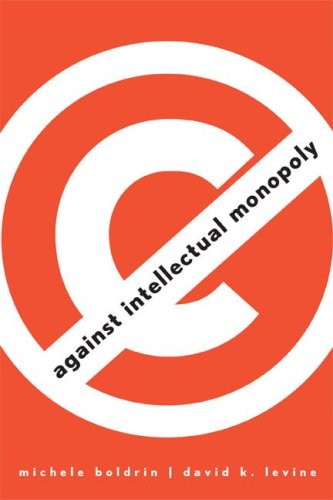
Boldrin and Levine have published THE BOOK


David Levine has announced that the long-awaited book Against Intellectual Monopoly, co-authored by Michele Boldrin and him, is now out, though it's not yet being shipped by Amazon, to which I can attest, having pre-ordered it a week ago. I read the early version last year and loved it.

Boldrin and Levine write in their blurb,

"Intellectual property" - patents and copyrights - have become controversial. We witness teenagers being sued for "pirating" music - and we observe AIDS patients in Africa dying due to lack of ability to pay for drugs that are high priced to satisfy patent holders. Are patents and copyrights essential to thriving creation and innovation - do we need them so that we all may enjoy fine music and good health? Across time and space the resounding answer is: No. So-called intellectual property is in fact an "intellectual monopoly" that hinders rather than helps the competitive free market regime that has delivered wealth and innovation to our doorsteps. This book has broad coverage of both copyrights and patents and is designed for a general audience, focusing on simple examples. The authors conclude that the only sensible policy to follow is to eliminate the patents and copyright systems as they currently exist.


Tonight after adding a Facebook "Pieces of Flair" button with the Swedish Pirate Party symbol, I happened to meander over to the US Pirate Party website, which had seen many months of apparent dormancy. I noticed no real activity until tonight. Now it looks like there've been some stirrings behind the scenes, starting with a "constitution" ratifed in Nov 2007. In Jan 2008 reportedly a 527 organization was registered. Tonight, despite periodically checking their main website for signs of life amidst the spam, was the first I became aware of this.

Sadly the positions Boldrin and Levine espouse do not seem to be welcome there, despite my efforts in 2006, making arguments on their wiki to which Levine himself contributed directly, and attending collegially the IRC meetings until the quorum flickered out. Judging from what I saw tonight on the wiki and the constitution, upon which more than a comment is due, the US Pirate Party now treats abolitionists as personae non gratae. On both patents and copyrights, the US Pirate Party 527 organization now is strictly reformist. This is odd since the Swedish Pirate Party calls for the abolition of patents. This fork did not need to happen. What to call the pirates who aren't "pirates"?

I'm looking forward to reading Boldrin and Levine's book just so that I know I'm not alone in my thoughts and imagination as a free pirate.

Update (Jul 13, 2008):
Here's a quote from Boldrin and Levine's Jan 2, 2008, online edition of Against Intellectual Monopoly, showing their abolitionist stripes,
Once the lobbyist's nose is inside the tent, the entire lobby is sure to follow, and we will once again be faced with a broken patent system and absurdly long copyright terms. To secure our prosperity and freedom we must abolish intellectual monopoly from the tent entirely. (p. 300)


Update (Jul 13, 2008, 10:52 pm Central): I just noticed on the US Pirate Party wiki, which has been damaged by spam—the footnotes are now missing (here they are in a well-formatted copy of the original)—, that one prominent member, Ray Jenson, Operations Officer of the Pirate Party of the United States, wrote this response to an argument made by David Levine,
There is no evidence that copyright serves to increase new creations??? You're obviously not a student of history.
This was Jenson's full response to Levine, as far as I can tell.

Here was David K. Levine's argument,
If I may add here. The bottom line is that they do get paid. The situation with patent and copyright is different, and in both cases there are a great many ways of getting paid. The problem is that there is a seemingly compelling theory of why people won't get paid - without IPR no one needs to pay because consumers will prefer to wait until it is available for free rather than pay the creator. There are two defects in this argument, one most relevant to patent, one to copyright. In the case of patent, the argument ignores the property right that exists without IPR, the property right in the first copy. Unless someone pays for the first copy, the innovator has no reason to make known the innovation. The right to go first is extremely valuable in fact. It is easy to debate the theory on either side. But the facts are pretty clear: there is no evidence that patents increase innovation, and plentiful evidence they do not. Two particularly good sources: Lerner's study [1] of 150 years of data on patents and innovation, and the careful study of the software industry by Bessen and Hunt [2] showing that patents reduced rather than increased innovation. Basically, while patents increase the return from innovation, they increase the cost due the need to acquire IPRs in order to innovate. So from a theoretical standpoint, patents can either increase or decrease innovation, depending on which effect dominates. In software it seems it is the latter; in general, it seems that it is something of a wash. It is important here to recognize that in addition to the effect on innovation patents have an impact on the usefulness of innovation. Hence, to justify patents from an economic point of view, not only must they increase innovation, they must increase innovation substantially enough to offset the other costs. The evidence is strong that they do not.

Turning to copyright, there is again no evidence that copyright serves to increase new creations. Simply looking at the time-series of copyright changes against the number of copyrights shows this pretty clearly - see for example my work with Boldrin [3]. The best comparative study is the book by Scherer Quarternotes and Banknotes documenting the fact that copyright had little or no effect on the output of classical music. The best pro-copyright argument is one of "now things are different because the electronic reproduction is so amazingly fast and cheap." This argument also is defective. First, it is the amount you can earn relative to the cost of production that matters - the same technology that makes electronic reproduction so amazingly fast and cheap also makes the cost of production amazingly cheap. Second, it ignores the potential for selling complementary items. The obvious examples are recorded music increases the demand for the creators live performances. So there is a perfectly viable model where recorded music is given away for free as advertising for the expensive concerts where the creator makes his living. The working example of this is the open-source software music, where the software is generally not only free as in freedom, but also free as in beer, with the profit coming from the sale of consulting services. added by David K. Levine, 10 November 2006.

I'm saddened that this Pirate Party organization has now excluded those who advocate abolition of either patents or copyrights from their ranks, as I understand it.

Levine, backing up my argument that the party allow abolitionists to participate as officers and members, wrote,
I urge support for Casey on this point. I've added material below explaining why patent and copyright are an intrinsically bad idea. It is possible to have principled disagreement on this point. I would urge the point of agreement to be that things have gone too far - that is, we agree that improvements need to be made. Does the party need to take a stand also against abolition? Would it not make more sense to be agnostic on this point? There are many of us who support abolition, but we support also sensible changes in existing law. added by David K. Levine 22 November 2006

Friday, April 11, 2008

The pirate's dilemma

Phenomenal book. Best story so far—I'm halfway through—is on the evolution of the game industry.


Update (Jul 26, 2008):

Friday, March 21, 2008

Princeton professor reportedly threatened

Ed Felten, professor at Princeton University, my alma mater, reports that he has received a letter from Sequoia Voting Systems threatening to stop people like him from investigating their voting machines, threatening him with the law. Are you starting to see why I'm so concerned about the future? of universities... of our constitutional republic? Can I get more shrill? I cannot think of a more striking example of how intellectual monopoly grants may prove our downfall. Other examples can be more subtle, even though they, too, threaten our viability as a relatively successful experiment in freedom. It's hard to explain "patent thickets" and how they had to be cleared, for example, in wartime out of sheer necessity. They got in the way of progress. This one, this letter, is simple and clear. Anyone can understand it and its relationship to the core of our government. This is why I, for one, risk spouting the heresies I do.

Here is the reported letter -

Sender: Smith, Ed [address redacted]@sequoiavote.com
To: felten@cs.princeton.edu, appel@princeton.edu
Subject: Sequoia Advantage voting machines from New Jersey
Date: Fri, Mar 14, 2008 at 6:16 PM

Dear Professors Felten and Appel:

As you have likely read in the news media, certain New Jersey election officials have stated that they plan to send to you one or more Sequoia Advantage voting machines for analysis. I want to make you aware that if the County does so, it violates their established Sequoia licensing Agreement for use of the voting system. Sequoia has also retained counsel to stop any infringement of our intellectual properties, including any non-compliant analysis. We will also take appropriate steps to protect against any publication of Sequoia software, its behavior, reports regarding same or any other infringement of our intellectual property.

Very truly yours,
Edwin Smith
VP, Compliance/Quality/Certification
Sequoia Voting Systems

[contact information and boilerplate redacted]


Let's free Popper's world 3, the world of objective knowledge. We're not abolishing the constitution and ignoring the declaration; we're fulfilling them, particularly the spirit of the first amendment.

Hat tip: WendyMcElroy.com

Update (Mar 21, 2008): It just doesn't add up. My mother once warned me that someday 2 + 2 might equal 5. Has that day come? Move along.

Tuesday, December 04, 2007

Universities must be free

Here is one concrete example of what I fear from the dependency that the Democratic Party fosters. In this case, universities are to begin censoring bits, lest all of their students lose the support they have come to depend upon. I fear for the very institution.

Democrats: Colleges must police copyright or else

by Anne Broache and Declan McCullagh
CNET News.com
Nov 9, 2007


I speak from experience. In the 80s, I saw at Stanford a culture where you could be asked to work on a military project with the understanding that "Those who say, 'No', don't get very far." This was my first dose of the reality of where dependency leads.

There were efforts then to try to restrict the free flow of information on research. Stanford at that time, through its relative independence, could insist that it not do classified research in contrast to another Bay Area university, which I shall leave unnamed, at least to my understanding then. Stanford Research Institute would do such classified research, separate from the University, if memory serves.

Universities must be free. The world of ideas must be free. The Enlightenment depends on it.

I'm glad to see that the president of Stanford University, John Hennessy, signed a letter in protest to such draconiana.

According to Aanchal Kapoor of Pomona's The Student Life, the bill in question, the College Opportunity and Affordability Act of 2007, was approved by a House committee, and,

The U.S. Senate approved its version of the bill in August. If the House version is approved in a vote next month, the two bills will move towards reconciliation.

Update (Mar 20, 2008): This week Ben DuBose wrote an article for the Los Angeles Times on the bill - Privacy provision aims at universities.

Thanks to OpenCongress.org you can follow the progress of the bills in the House HR 4137 and in the Senate S 1642.

Update (Aug 2, 2008):
The Senate passed HR 4137 on July 29. It now awaits the President's signature.

Hat tip: Mashable twitter.

See also:

Tuesday, November 20, 2007

Outlaw kids


Great presentation at TED by Larry Lessig (though I disagree with Lessig's not taking his own ideas to their logical denouement). His last point is most salient. I remember bringing this point up with my young nephew a couple of years ago. If we don't address the issue of intellectual monopoly, the new generation will experience together a deep contempt for the law, stemming from their natural activity being forced underground.

Update (Nov 29, 2007): John Tehranian has written a paper on the norm/law gap amongst normal citizens, taking as an example one day in the life of a professor, Infringement Nation: Copyright Reform and the Law/Norm Gap. Here's a summary of that paper. How many times do you casually reply to email in one day? 20 casual replies, if copyright law were enforced, would cost this professor some $3 million, if he were to slip up and unwittingly quote his senders' messages. For shame!

Hat tip: Just an Online Minute

Sunday, November 18, 2007

Liberty can bring us together: letter to a Democratic Party voter

I come from a staunch Democratic background, with quite a bit of education in my pocket that refined my liberalism, while retaining the spirit of it all. After having worked for McGovern, having voted for Carter, and having voted for Mondale, I voted for Ron Paul in 1988 after I read Hayek's Road to Serfdom. For some ineffable reason, I have more hope in the long run for Democratic Party voters coming around to liberty than I do for Republican Party types. I see no hope in the Democratic Party itself, given that it learned nothing from its defeat in 1994 over its attempts at health care government domination.

What is the problem with the Democrats? They themselves create much of the mess they fight against, particularly with regard to unjust concentrations of wealth.

Complex, arbitrary laws create barriers to entry that foment cartels and monopolies. Witting and unwitting Democrats create major unintended consequences in their flood of legislation. The witting Democrats profit from a lack of competition and the rise of dependency.

Meanwhile, the law drowns in its own flood. How does the little guy feel when facing this quagmire that has become our legal system? The little guys group into herds for protection.

And I don't feel consoled when Democrats argue to remedy this mess by creating a company-town writ-large. It all smacks of Hayek's Road to Serfdom, which I don't think anyone really wants.

(The Republicans have their own sad demons they foment. As they fight the drug war in Afghanistan, are they not creating a significant material root that nourishes the growth of jihadism? Could the rise of terrorism be akin to the rise of organized crime during Prohibition? It's sad when you fight a beast you nurse. Anyway, back to the subject at hand...)

What's one to do? The parties seem to be pretty much locked in.

Unfortunately, as anyone knows who has tried to go the third-party route, there are artificial political barriers to entry. This leaves our political system vulnerable to stagnation and to the rise of unrestrained factions. Suppose, for argument's sake, all parties but two were illegal. What would be the difference between such a two-party state and a one-party state?

I think the real question is - Are liberals really welcome in either the Democratic or Republican parties?

A liberal is first and foremost someone who believes in rights.

Where can a liberal find his'r'r home?

Anyway it's all very sad, but for some reason I think liberty can bring us together again somehow.

I would recommend your reading Nobel laureate economist's James Buchanan's recent book which is a call for "the ethics of liberalism" and a response to Hayek.


Update (Nov 29, 2007): A hopeful sign. One man amidst "the left" sees the company-town writ-large which John Edwards threatens us with. Matt Stoller writes,
So at the end of the day, if you don't have health care, your wages will be garnished or your credit will be damaged because a collection agency will see to it that you buy your insurance. You might even go bankrupt! And since it's called a mandate, we'll need a new IRS-like bureaucracy to handle all of this, but it won't be the IRS since a mandate is not a tax, it's just a required fee you pay to a private company.
It's a funny thing how incongruities can finally catch up with you.

Stoller also attacks Hillary Clinton, whose central plan would "require a massive Orwellian nightmare to enforce the purchase of private insurance by those least able to afford it."

Speaking myself from the classical liberal diaspora, it's perhaps a first ray of hope, that the warmth of the enlightenment might actually return to freethinking types.

Matt Stoller describes the approach of his website OpenLeft,
It's time to get over the idea that 'the left', liberals, progressives, or anyone who believes that power should be distributed and not concentrated in the hands of a few is a scary hippy. And that's why we called the site 'OpenLeft'; we see our ideas as a mark of pride, not shame. We think that businesses - like Google - have built highly profitable organizations based on principles of sharing information and distributing power. The genuine radical threat at this moment in history is coming from elites who believe that concentrating power, information, and wealth in their hands should be America's priority.


Stoller does defend Barack Obama, recommending that Obama say,
"How is Senator Clinton going to force everyone to sign up for health care insurance? She's mentioned forcing citizens to have a health care insurance card in order to get a job, which is a crazy intrusive idea that is not acceptable."


Why the blind spot on Obama? Conservative HotAir's Bryan Preston points out how Obama, too, flirts with totalitarian doublethink, quoting ABC,
Obama says he would enforce his mandate for health care for all children by fining parents if they refused to allow health care coverage for their children.

"I am happy to be very clear how we enforce mandates for children, and the reason is because children don't have an option."

How kind of Obama to baptise our children into the Democratic Party's way of doing things, parents be damned, despite vague protestations about a "Constantinian Fall" or some such nonsense.

I've worried about our Road to Serfdom for 20 years, which explains my parting company with the Democratic Party. Now, with the cries of Naomi Wolf, it mystifies me how Democrats of good will could call for government control if our form of government is lapsing.

Milton Friedman said our freedom was a rare thing [17:39]. Are we to lose it to the chaos of the ages again? Or shall we stand for liberty?

Thursday, October 04, 2007

New York, New Hampshire, and Williamsburg - deadline October 12 for douche-free election

If you live in New York or New Hampshire, or Williamsburg, and you don't want to have to choose between a giant douche and a turd sandwich next November, all you have to do is follow this wise woman's advice, but you don't have much time. Be sure to let your friends know how clutch it was for them to get this done before the deadline on Friday!!! I did my part when I was 20-something, now it's up to you to move the ball up the field. Hold your nose so you don't have to hold your nose.


Ron Paul Girl - Register Now! - video powered by Metacafe

Source: Liv Films

South Park - Turd Sandwich vs. Giant Douche


Add to My Profile | More Videos

Here's a bonus song for New Yorkers.


Update (Oct 7, 2007):
Attention New Yorkers and Burgers. Apparently Ron Paul is not a "nationally known" candidate and so will not even appear on the Republican primary ballot in February. If you do register, please sign a petition or two to have his name appear on the ballot. And I thought this was only a problem for third-party candidates. Currently his chances (6½%) for the GOP nomination place him in 4th place ahead of McCain according to the prediction market contract prices at intrade.